




Assistant Professor, Department of Pharmaceutical Education & Research (DPER), BPSMV, Khanpur Kalan, Sonepat, Haryana, India
September 04, 2026
Assistant Professor, Department of pharmaceutical education and research, BPSMV, Bhainswal kalan, sonipat, Haryana, India
September 04, 2026
Assistant Professor, School of Pharmacy, Desh Bhagat University, Mandi Gobindgarh, Punjab, India
September 04, 2026
Adesh Institute of Pharmacy and Biomedical Sciences, Adesh University, Bathinda, Punjab,India.
September 04, 2026
PhD research scholar at Institute of Pharmaceutical Sciences, Kurukshetra University, Thanesar, Kurukshetra, Haryana, India
September 04, 2026
Associate Professor in the Department of Applied Sciences at Desh Bhagat University, Mandi Gobindgarh, Punjab, India
September 04, 2026
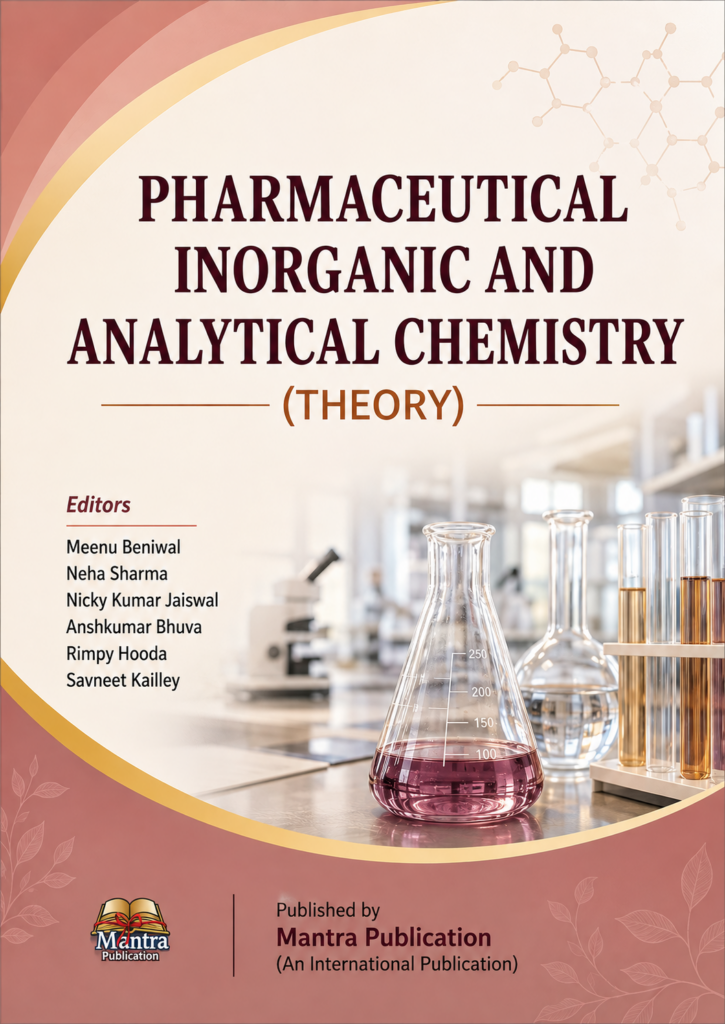
Pharmaceutical analysis and pharmaceutical inorganic chemistry form the backbone of pharmaceutical education and practice. A sound understanding of analytical principles, chemical behaviour, quality control, and therapeutic relevance is essential for pharmacy students. This book has been designed to present these concepts in a clear, systematic, and student-friendly manner.The content is organized into five units, beginning with pharmaceutical analysis, covering its scope, techniques, solution strength, standardization, errors, accuracy, precision, impurities, and limit tests. The second unit focuses on acid–base chemistry, pH, buffer systems, isotonicity, and physiological electrolytes, which are vital in formulation science. The third unit deals with volumetric analysis, including various titrimetric methods and their pharmaceutical applications. The fourth unit discusses gastrointestinal agents, antimicrobials, and radiopharmaceuticals, highlighting their properties, mechanisms, assays, and safety aspects. The fifth unit includes miscellaneous compounds such as haematinics, expectorants, poisons, and antidotes, linking chemistry with therapeutic use. A student-centered approach has been adopted with learning objectives, summaries, examples, and review questions. The language is kept simple yet scientifically accurate, ensuring conceptual clarity and practical relevance. This book is intended for students, teachers, and professionals in pharmaceutical sciences. We hope it will strengthen understanding, encourage scientific thinking, and support academic and professional growth in pharmacy.
04 September 2026
Copyright © 2026 Meenu Beniwal , Neha Sharma , Nicky Kumar Jaiswal, Anshkumar Bhuva , Rimpy Hooda, Savneet Kailley
ISBN
978-81-68473-05-8
ISBN
978-81-68473-04-1
