





Principal, SBMNUTC, Department of Pharmacy (D.Pharm), Shri Baba Mastnath University Technical Campus, Baba Mastnath University, Asthal Bohar, Rohtak, Haryana, India.
September 28, 2026
Assistant Professor, Pharmaceutical Chemistry, PES Modern College of Pharmacy, Nigdi, Pune, Sector 21, Yamuna Nagar, Nigdi, Pune, Maharashtra, India.
September 28, 2026
Assistant Professor, Pharmaceutics, Chandrapur College of Pharmacy, Sarkar Nagar, Near CHL Hospital, Chandrapur, Maharashtra – 442401, India.
September 28, 2026
Assistant Professor, Pharmacology, H.K. College of Pharmacy, Jogeshwari West, Mumbai, HK Campus, Relief Road, Oshiwara, Jogeshwari West, Pratiksha Nagar, Mumbai, Maharashtra – 400102, India.
September 28, 2026
Associate Professor, Pharmaceutics, Swami Vivekanand Sansthas Institute of Pharmacy, D. Pharmacy, A/P-Mungase, Tal-Malegaon, Dist-Nashik, Maharashtra, India.
September 28, 2026
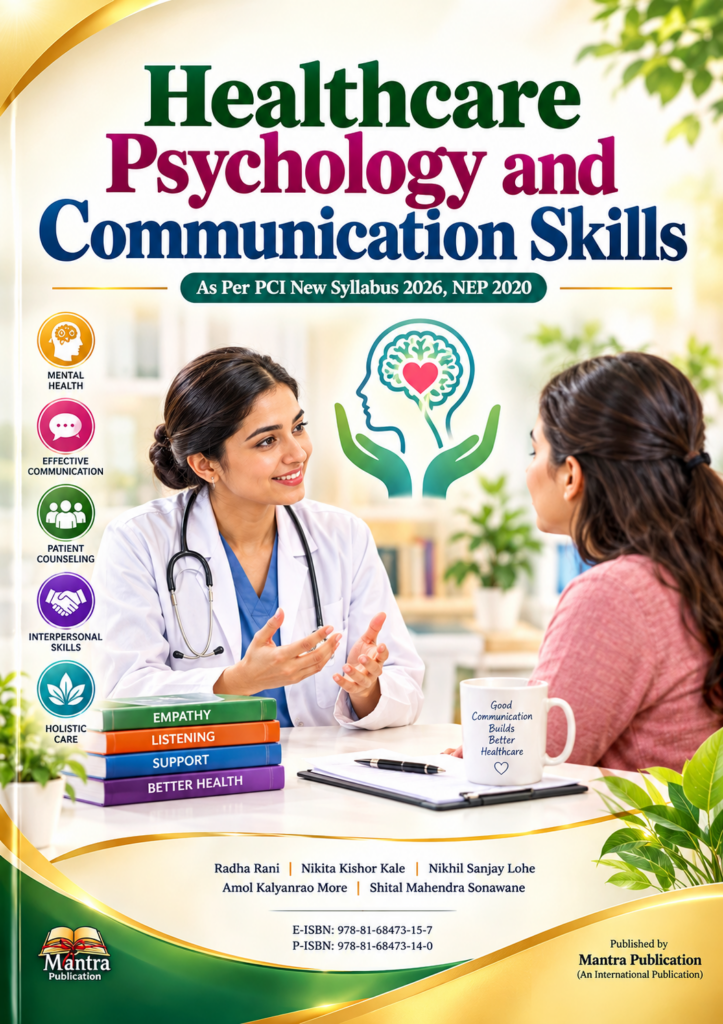
Healthcare is not limited to the diagnosis and treatment of disease; it also involves understanding people, their emotions, behaviours, beliefs, and responses to illness. Effective communication and psychological understanding are therefore essential components of quality healthcare. Healthcare professionals interact with patients, families, colleagues, and multidisciplinary teams every day, making communication skills and psychological knowledge important for safe, compassionate, and patient-centred care.
The book Healthcare Psychology and Communication Skills has been prepared to provide students with a structured understanding of the psychological principles and communication techniques relevant to healthcare settings. It introduces fundamental concepts of psychology and explains how sensation, perception, learning, memory, emotion, motivation, personality, stress, coping, and human development can influence health and illness. The book also discusses common psychological disorders, resilience, stress management, psychological first aid, mental health promotion, and stigma reduction.
A major emphasis of this book is on effective healthcare communication. Healthcare professionals need to communicate information clearly, listen actively, demonstrate empathy, ask appropriate questions, maintain professional relationships, and communicate respectfully with individuals from diverse cultural and social backgrounds. The book therefore covers verbal and non-verbal communication, active listening, questioning techniques, empathy, culturally appropriate communication, patient records, reports, discharge summaries, and the use of digital communication technologies in healthcare.
The chapters have been organized in a systematic manner to facilitate classroom teaching, self-learning, and examination preparation. Important concepts are presented in clear and accessible language, with suitable examples and practical healthcare contexts wherever appropriate. The book is intended to help learners connect theoretical psychological concepts with real-life healthcare situations.
We hope that this book will serve as a useful academic resource for students pursuing pharmacy, nursing, allied health sciences, medical and other healthcare-related programmes. It may also assist teachers and healthcare professionals in reinforcing their understanding of psychological principles and professional communication.
The authors acknowledge that healthcare psychology and communication are broad and continually developing areas. Suggestions, constructive feedback, and corrections from readers and teachers are sincerely welcomed for future editions.
28 September 2026
Copyright © 2026 Radha Rani, Nikita Kishor Kale, Nikhil Sanjay Lohe, Amol Kalyanrao More, Shital Mahendra Sonawane
ISBN
978-81-68473-15-7
ISBN
978-81-68473-14-0
