





Assistant Professor, Swami Vivekanand Institute of Engineering & Technology, Banur (Patiala) Punjab, 140601
 https://orcid.org/0009-0007-6552-279X
August 30, 2026
Assistant Professor, Swami Vivekanand Institute of Engineering & Technology, Banur (Patiala) Punjab, 140601.
https://orcid.org/0009-0005-0323-6443
August 30, 2026
Professor, Swami Vivekanand Institute of Engineering & Technology, Banur (Patiala) Punjab, 140601
https://orcid.org/0000-0003-3757-7623
August 30, 2026
Artificial Intelligence (AI) has become one of the most influential technologies of the twenty-first century, transforming the way people live, work, and interact with technology. What was once considered a futuristic concept is now an essential part of everyday life. From virtual assistants and recommendation systems to autonomous vehicles, healthcare diagnostics, and intelligent automation, AI is driving innovation across almost every sector. As industries increasingly adopt AI-based solutions, understanding its concepts and applications has become essential for students, researchers, professionals, and lifelong learners.
Artificial Intelligence is no longer confined to computer science laboratories or research institutions. It is widely used in healthcare for disease diagnosis and medical imaging, in education for personalized learning, in agriculture for precision farming, in finance for fraud detection and risk analysis, in manufacturing for automation and predictive maintenance, and in transportation for intelligent traffic management and autonomous vehicles. These applications demonstrate the significant role AI plays in addressing real-world challenges and improving efficiency, productivity, and quality of life.
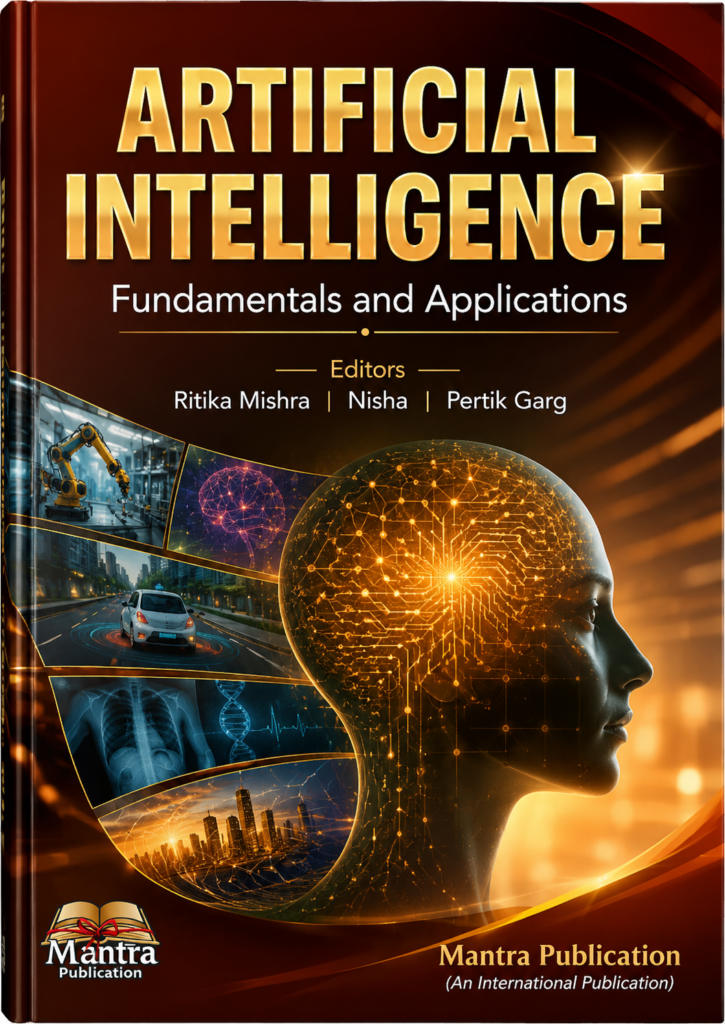
Recognizing the growing importance of Artificial Intelligence, this book, Artificial Intelligence: Fundamentals and Applications, has been written to provide readers with a comprehensive yet accessible introduction to the subject. The primary objective of this book is to present the fundamental concepts of AI in a simple, systematic, and learner-friendly manner while connecting theory with practical applications. The content is carefully organized to help readers build a strong conceptual foundation before exploring advanced AI technologies.
The book begins by introducing the evolution and history of Artificial Intelligence, followed by the basic principles of intelligent systems, problem-solving, search techniques, knowledge representation, reasoning, and intelligent agents. These concepts provide the foundation for understanding how machines simulate human intelligence and make intelligent decisions. The book then explores Machine Learning, which forms the backbone of modern AI systems. Readers will gain an understanding of supervised, unsupervised, and reinforcement learning techniques, along with commonly used algorithms for prediction, classification, clustering, and optimization.
In addition, the book discusses Deep Learning and Artificial Neural Networks, highlighting how layered neural models enable computers to perform tasks such as image recognition, speech processing, and complex pattern analysis with remarkable accuracy. Important topics such as Natural Language Processing (NLP), Computer Vision, Robotics, and Intelligent Automation are also presented, enabling readers to understand how AI systems process language, interpret visual information, and interact with the physical world.
We sincerely hope that Artificial Intelligence: Fundamentals and Applications serves as a valuable resource for students, educators, researchers, and professionals. It is our aspiration that this book inspires readers to explore innovative ideas, develop intelligent solutions, and contribute responsibly to the advancement of Artificial Intelligence for the betterment of society.
30 August 2026
Copyright © 2026 Ritika Mishra, Nisha, Pertik Garg
ISBN
978-81-68473-01-0
ISBN
978-81-68473-00-3