




Assistant Professor, Department of Pharmaceutical Sciences, HNB Garhwal University, Uttarakhand, India.
October 25, 2026
Assistant Professor, Department of Pharmacy, Sarala Birla University, Vill. Ara, P.O. Mahilong, Ranchi–Puruliya Highway, Ranchi–835103, Jharkhand, India.
October 25, 2026
Assistant Professor, Pharmaceutics, Sarala Birla University, Ara, Purulia Road, Mahilong, Ranchi, Jharkhand, India.
October 25, 2026
Professor, Academic Director and Head, Department of Pharmaceutics, Krishna Teja Pharmacy College, Chadalawada Nagar, Renigunta Road, Tirupati, Andhra Pradesh, India.
October 25, 2026
Assistant Professor, School of Pharmacy, ARKA JAIN University, 312/A, Opposite Kerala Public School, Dist. Gamharia, Jamshedpur, Mohanpur, Jharkhand–832108, India.
October 25, 2026
Physical Pharmaceutics is one of the fundamental subjects in pharmaceutical education, providing the scientific principles necessary to understand the physical and physicochemical properties of drugs and pharmaceutical dosage forms. It establishes a connection between basic pharmaceutical sciences and the formulation, development, evaluation, and performance of pharmaceutical products. A sound understanding of this subject is essential for pharmacy students to develop the knowledge and skills required for pharmaceutical research, formulation development, and industrial practice.
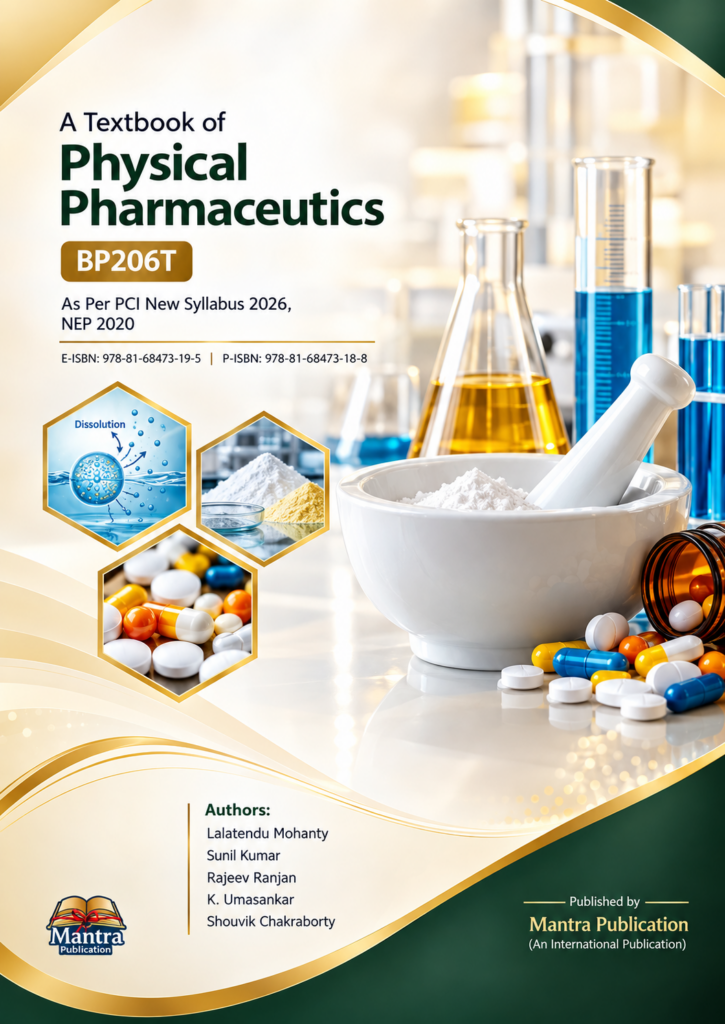
A Textbook of Physical Pharmaceutics (BP206T) has been prepared to provide a comprehensive and systematic understanding of the fundamental concepts of physical pharmaceutics in accordance with the academic requirements of the Bachelor of Pharmacy (B. Pharm.) programme. The book presents the subject matter in a clear, organized, and student-friendly manner, facilitating effective learning and a better understanding of the principles involved. It covers important topics such as solubility and distribution phenomena, buffers, interfacial phenomena, colloidal and coarse dispersions, rheology, and micromeritics, emphasizing their theoretical foundations and pharmaceutical applications.
The content has been structured to help students understand the relationships between physicochemical properties and the formulation, stability, processing, and performance of pharmaceutical dosage forms. Relevant definitions, explanations, equations, examples, and pharmaceutical applications are incorporated wherever appropriate to support conceptual clarity and encourage the practical application of theoretical knowledge. The systematic presentation of the topics is intended to assist students in classroom learning, examination preparation, and the development of a strong foundation for advanced pharmaceutical subjects.
This textbook is primarily intended for undergraduate pharmacy students and may also serve as a useful reference for teachers, researchers, and pharmaceutical professionals seeking to revise fundamental concepts of physical pharmaceutics. The authors hope that the book will promote scientific curiosity, independent learning, and a deeper appreciation of the role of physical pharmacy in modern pharmaceutical sciences.
We sincerely acknowledge the contributions and support of all those who have encouraged and assisted in the preparation of this textbook. We also welcome constructive suggestions and feedback from readers and academic colleagues, which will help improve the quality and usefulness of future editions.
We hope that A Textbook of Physical Pharmaceutics (BP206T) will prove to be a valuable learning resource and contribute meaningfully to the academic and professional development of pharmacy students.
25 October 2026
Copyright © 2026 Lalatendu Mohanty, Sunil Kumar, Rajeev Ranjan, K. Umasankar, Shouvik Chakraborty
ISBN
978-81-68473-19-5
ISBN
978-81-68473-18-8
